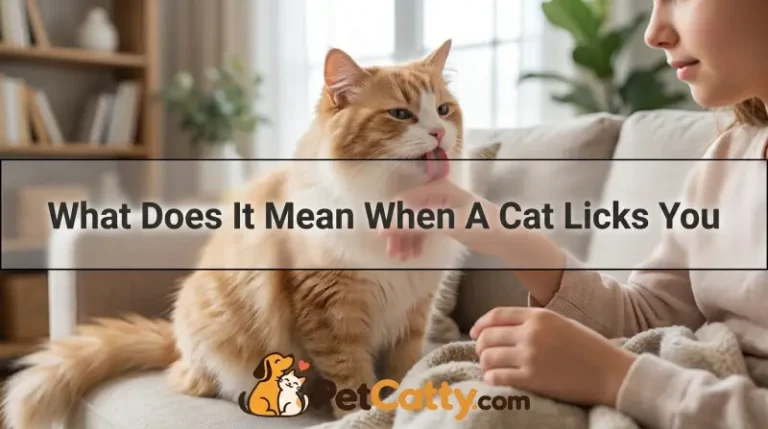
You're sitting there, enjoying a quiet moment with your cat. They're purring, licking your hand, everything feels great. Then, out of nowhere, they bite you.
It's confusing, sometimes painful, and it makes you wonder what you did wrong. The question "why does my cat lick me then bite me" is one of the most common puzzles cat owners face. The answer is simpler than you think: your cat is communicating clearly.
You just need to learn the language.
Veterinary behaviorists at the American Association of Feline Practitioners (AAFP) confirm that this behavior is rarely random or aggressive. It's a signal. Once you know what to look for, you can prevent it most of the time.
Let's break down what's really going on.
Quick Answer
Your cat licks you to show affection and then bites you to say "stop." It's a communication signal. The bite usually means overstimulation, playfulness, or a love bite. Look for tail twitches, ear flattening, or skin ripples before the bite.
Stop petting when you see these signs. Do not pull your hand away fast.
What Your Cat Is Trying to Tell You
Cats don't speak English. But they have a rich vocabulary of behaviors. Licking and biting are two very different messages that often get combined.
Understanding each part separately is the first step.
The Lick: "I Trust You"
When your cat licks you, they're doing something deeply social. Mother cats lick their kittens to groom and bond. Adult cats lick each other as part of their social group.
When your cat licks your hand, arm, or face, they're essentially saying "you're family." It's a sign of affection, trust, and comfort.
Some cats also lick because they like the taste of salt on your skin. That's a secondary reason. The primary one is social bonding.
If your cat is purring while they lick, that's a strong indicator they're feeling content and safe.
The Bite: "I Need a Change"
The bite that follows the lick is where the confusion starts. It's rarely a full-on aggressive bite. Most of the time, it's one of three things:
- A gentle "love bite" that doesn't break skin
- A sharp "I'm overstimulated" nip
- A playful "let's wrestle" grab
The bite pressure tells you a lot. A gentle mouthing with no pressure is usually affection. A quick, sharp nip that makes you jump is overstimulation.
A hard grab with claw involvement is play aggression or fear.
The Combination: Mixed Signals
The sequence of lick-then-bite is what trips people up. It feels like a betrayal. "You were just being nice, why are you biting me?" From your cat's perspective, it's a polite escalation.
The lick is the first message: "I like you." The bite is the second message: "But I'm done with this specific interaction."
Think of it like a friend who says "I love hanging out with you" and then stands up to leave. The message isn't contradictory. It's sequential.
First the affection, then the boundary.
The 3 Most Common Reasons Cats Do This
Not all lick-then-bite behaviors are the same. The reason changes based on context, your cat's personality, and what's happening in the moment. Here are the three most common scenarios, ranked by how often they occur.
| Reason | Frequency | Key Sign | Typical Bite Pressure |
|---|---|---|---|
| Petting-induced aggression (overstimulation) | Most common | Tail twitching, skin ripples, ear flattening | Sharp, quick nip |
| Play aggression | Common in kittens and young cats | Dilated pupils, pouncing posture, hunting crouch | Grab with claws, harder bite |
| Affection bite (love bite) | Moderate | Purring, relaxed body, slow blinking | Gentle mouthing, no pressure |
1. Petting-Induced Aggression (Overstimulation)
This is the number one reason cats lick then bite during petting. It's not aggression in the mean sense. It's a sensory overload response.
Cats have a threshold for how much petting they can tolerate before it becomes uncomfortable.
Here's what happens. You start petting your cat. They enjoy it.
They purr. They lick your hand. After a certain number of strokes, usually between 5 and 15, the sensation shifts from pleasant to irritating.
It's like a tickle that becomes too much. Your cat's nervous system says "enough." The fastest way to make it stop is a quick bite.
The bite is not personal. It's not anger. It's a reflex.
Your cat is saying "I loved that, but now I need you to stop." The licking was the "I loved that" part. The bite is the "stop" part.
2. Play Aggression
This is more common in kittens and cats under two years old. Play aggression happens when your cat's hunting instincts kick in. Your hand moving during petting looks like prey.
The licking is a grooming behavior that precedes wrestling in cat play. The bite is the pounce.
If your cat's eyes are dilated, their ears are forward, and their body is in a crouched position, this is play mode. They're not trying to hurt you. They're practicing their hunting skills.
The problem is that human skin is not as tough as a toy mouse.
3. Affection Bites (Love Bites)
Some cats gently mouth their owners as a sign of affection. It's a soft bite that doesn't break skin. It's often accompanied by purring, kneading, and slow blinking.
This behavior is more common in cats that were handled a lot as kittens.
The licking is grooming. The bite is a gentle nibble that mimics how cats groom each other. Some cats also do this when they're feeling particularly bonded and happy.
It's not a warning. It's a love language. But it can still be surprising if you're not expecting it.
How to Tell Which One It Is: A Decision Tree
You don't need to guess. You can figure out exactly what's happening by following a simple process. The key is to observe your cat before, during, and after the bite.
Step 1: Check the Context
Ask yourself: What were we doing right before the bite?
- Were you petting your cat? Go to Step 2.
- Were you playing or wrestling? Likely play aggression. Use a toy instead of your hands.
- Were you just sitting still? Likely affection bite or attention-seeking.
- Did you just stop petting? Some cats bite to say "don't stop." This is a different signal.
Step 2: Read the Body Language
Look at your cat's body in the 10 seconds before the bite. This is the most important step. You can often predict the bite before it happens.
| Body Signal | What It Means |
|---|---|
| Tail twitching or thumping | Overstimulation is building. Stop petting now. |
| Ears flattening to the sides (airplane ears) | Uncomfortable, about to bite. |
| Skin rippling along the back | Sensory overload. Bite is coming. |
| Dilated pupils (wide, dark eyes) | High arousal, could be play or fear. |
| Slow blinking, relaxed ears, loose body | Affection. Bite will be gentle if it comes. |
| Crouched posture, hind legs tensed | Play aggression. Ready to pounce. |
If you see any of the first four signals, the bite is coming. You have a few seconds to stop petting and move your hand away slowly.
Step 3: Assess the Bite Pressure
After the bite, evaluate what it felt like.
- Gentle mouthing, no pain, no skin break, Affection bite. Nothing to worry about.
- Sharp, quick nip that makes you flinch, Overstimulation. You missed the warning signs.
- Hard grab with claws, multiple bites, Play aggression or fear. Your cat is in hunting mode or scared.
- Deep bite that breaks skin, Either extreme fear, pain, or a medical issue. This needs a vet visit.
Step 4: Count the Strokes
If you were petting your cat, count how many strokes you did before the bite. Do this for a few days and note the pattern. Most cats have a consistent threshold.
Some cats tolerate 5 strokes. Some tolerate 20. Once you know your cat's number, you can stop petting one stroke before the bite.
Step 5: Make Your Move
Based on what you've observed, here's what to do next.
- If it's overstimulation: Stop petting. Stay still. Do not pull your hand away fast. Fast movement can trigger a chase instinct. Let your cat calm down for a few minutes.
- If it's play aggression: Redirect to a toy. Keep a wand toy or a crinkle ball nearby. Never use your hands as toys.
- If it's an affection bite: Accept it or gently move your hand away. Your cat is not upset. They're just expressing love in their way.
What to Do When It Happens (In the Moment)
The moment your cat bites you, your reaction matters. A bad reaction can make the behavior worse. A good reaction can prevent it from happening again.
Do This
- Stop all movement. Freeze your hand. Pulling away triggers the prey drive and makes the bite worse.
- Stay silent. Do not yell, shout, or make loud noises. Your cat doesn't understand punishment. They'll just get scared.
- Wait for your cat to release. Most cats let go immediately when you stop moving. If they don't, gently push your hand toward their mouth, not away. This surprises them and makes them release.
- Slowly withdraw your hand. Once they let go, move your hand away slowly. No sudden movements.
- Leave your cat alone for 5 to 10 minutes. Give them space to reset. Don't try to pet them again right away.
Don't Do This
- Don't pull your hand away. This is the most common mistake. It triggers the chase instinct and your cat bites harder.
- Don't yell or hit. Physical punishment damages trust and increases fear-based aggression. It never works long-term.
- Don't make eye contact. Staring is a threat signal to cats. Look away to de-escalate.
- Don't pick up your cat. A cat that just bit you is overstimulated. Picking them up can make it worse.
- Don't reward the behavior. If you give treats or affection immediately after a bite, you're teaching your cat that biting works. Wait until they're calm and relaxed.
A Note on Wound Care
If the bite breaks skin, clean the wound immediately with soap and warm water. Cat bites can cause serious infections because their teeth are sharp and narrow, pushing bacteria deep into the tissue. Monitor for redness, swelling, or warmth.
If you see any signs of infection, see a doctor. Cat scratch fever is real and it's not something to ignore.
Common Mistakes That Make the Biting Worse
Most cat owners accidentally reinforce the lick-then-bite behavior without realizing it. The good news is that these mistakes are easy to fix once you know what they are.
Mistake 1: Pulling Your Hand Away Fast
This is the most common reaction, and it's totally understandable. Something sharp just clamped onto your skin. Your instinct is to yank away.
But that instinct backfires with most cats.
Here's why. Cats are hardwired to chase quick-moving objects. When you pull your hand away fast, your cat's brain switches from "petting mode" to "hunting mode." That prey drive kicks in.
Now your cat isn't just holding on. They're actively trying to catch the escaping "prey." The bite gets harder. The claws come out.
You get more injured than you would have if you stayed still.
The fix: freeze. Your cat's mouth is already on you. Going still makes the bite boring.
Most cats let go immediately when the movement stops. Wait two seconds, then gently move your hand away.
Mistake 2: Petting the Belly
Cat bellies are a trap. It's not just a joke. It's biology.
The belly is a cat's most vulnerable area. In the wild, a cat exposes their belly only when they feel completely safe. But that doesn't mean they want it touched.
When your cat rolls over and shows their belly, they're signaling trust, not requesting belly rubs. If you reach in, they often respond by grabbing your hand with all four paws and biting. This is a reflexive defense of a vulnerable area.
It's not an invitation for more contact.
The fix: stick to the safe zones. The cheeks, chin, and the base of the ears are where most cats enjoy being petted. The tail base works for some.
The belly is usually off limits.
Mistake 3: Over-Petting Despite Warning Signs
Cats are great at giving warnings. Tail twitches, ear flattening, skin ripples, and sudden stillness are all signs that your cat has had enough. The problem is that many owners ignore these signals because they're enjoying the moment.
They keep petting. The cat is screaming "stop" through body language. The human is reading it as "more please."
The fix: learn your cat's threshold. Count strokes. Watch for the first tail twitch.
When you see it, stop. Your cat will learn that you respect their signals. They'll trust you more, not less.
Mistake 4: Using Your Hands as Toys
This is a big one, especially with kittens. It's tempting to wiggle your fingers and let your kitten pounce. It's cute.
It's fun. But you're teaching your cat that hands are acceptable play targets.
A cat that learns to bite hands during play doesn't automatically unlearn that as an adult. They generalize. Hand moves under the blanket?
Bite. Hand reaches for a pet? Bite.
Hand looks like it's playing? Bite.
The fix: always use a toy. Wand toys, laser pointers, crinkle balls, anything that puts distance between your hand and your cat's mouth. If your cat goes for your hand during play, stop moving immediately.
The game ends when teeth touch skin.
Mistake 5: Punishing the Cat
Yelling, spraying with water, tapping the nose, or any form of punishment after a bite does not work. It creates fear. Fear makes aggression worse.
A cat that's scared of you is more likely to bite sooner and harder next time.
Cats don't connect punishment to the behavior. They connect it to you. They learn that you're unpredictable and dangerous.
That's not the foundation of a good relationship.
The fix: use negative punishment instead. That means removing something good to decrease a behavior. When your cat bites, you end the interaction.
You walk away. You stop giving attention. That's a consequence your cat understands.
"When I bite, the good thing stops."
How to Prevent It From Happening Again
Prevention is about changing the pattern before the bite happens. You can't train a cat not to feel overstimulated. But you can train yourself to stop before they reach that point.
Learn Your Cat's Threshold
This is the single most effective prevention strategy. Spend a few days paying close attention to how many strokes your cat tolerates before they show signs of irritation. Most cats have a consistent number.
It might be 5 strokes. It might be 15. It might be more if you're petting their cheeks versus their lower back.
Once you know that number, stop one stroke before it. Your cat gets all the affection they want. You never get bitten.
Over time, some cats learn to tolerate a bit more. But don't push it.
Pet in the Right Spots
Not all petting is equal. Cats have distinct preferences for where they like to be touched.
| Sweet Spots | Risky Spots | Off Limits |
|---|---|---|
| Cheeks | Lower back | Belly (for most cats) |
| Chin | Tail base | Paws |
| Base of ears | Flanks | Tail tip |
| Top of head |
Stick to the sweet spots. If you venture into risky territory, watch for signs of discomfort. The lower back and tail base are common triggers for overstimulation bites.
Use the "Pet, Pause, Pet" Method
Instead of continuous petting, try short bursts. Pet for 3 to 5 strokes, then pause for 5 seconds. Let your cat process the sensation.
If they lean into your hand, pet again. If they look away or twitch their tail, stop.
This method works well for cats with low tolerance. It gives them a chance to reset between strokes. That can prevent sensory overload from building up.
Redirect Play Aggression
If your cat's bite is play-related, the solution is more appropriate play. Cats need to hunt. They need to chase, pounce, and bite.
If you don't provide an outlet, your hands become the outlet.
Schedule two to three active play sessions per day, 10 to 15 minutes each. Use wand toys that mimic prey. Let your cat catch the toy at the end of each session.
A tired cat bites less.
Create a Calm Environment
Stress makes everything worse. If your cat is generally anxious, their threshold for overstimulation drops. Look for sources of stress in your home.
- Is there enough vertical space? Cat trees, shelves, window perches.
- Are there hiding spots? Boxes, covered beds, quiet corners.
- Is there a consistent routine? Cats thrive on predictability.
- Is there conflict with other pets? That can raise overall tension.
Reduce stress, and you'll often see fewer issue behaviors.
When to See a Vet (Yes, Sometimes It's Medical)
Most lick-then-bite behavior is behavioral. But sometimes it's a sign of an underlying health problem. If your cat's behavior changes suddenly or becomes more frequent, a vet visit is a good idea.
Medical Conditions That Can Cause Biting
- Feline hyperesthesia syndrome. This is a neurological condition that causes extreme sensitivity along the cat's back. Touching the back can trigger a painful reaction, including biting. Look for skin rippling, dilated pupils, and frantic grooming.
- Arthritis or joint pain. A cat in pain may not want to be touched in certain areas. If your cat bites when you pet their lower back or hips, arthritis could be the cause.
- Dental pain. Oral pain can make cats irritable. If your cat bites when you touch their face or head, dental issues might be at play.
- Skin conditions. Allergies, flea infestations, or skin infections can make petting painful. If your cat's skin is sensitive, they may bite to say "that hurts."
- Hyperthyroidism or other systemic illness. Any condition that causes irritability or discomfort can lower your cat's tolerance for handling.
Red Flags That Warrant a Vet Visit
- The behavior started suddenly with no clear trigger.
- Your cat has never done this before and now does it frequently.
- The bites are hard and break skin every time.
- Your cat seems generally anxious or irritable, not just during petting.
- You notice other symptoms like weight loss, changes in appetite, excessive grooming, or hiding.
- Your cat is older and has never shown this behavior before.
What the Vet Will Do
A veterinary behavior visit typically starts with a full physical exam to rule out pain or illness. The vet may check your cat's teeth, joints, skin, and neurological responses. They'll ask about the behavior in detail, including when it started, what triggers it, and how your cat responds.
If no medical cause is found, the vet may refer you to a veterinary behaviorist or a certified cat behavior consultant. These specialists can work with you on a long-term behavior modification plan.
Real Scenarios: What This Looks Like in Practice
Theory is helpful. Real examples make it click. Here are three common scenarios that cat owners experience, with explanations of what's happening and what to do.
Scenario 1: The Belly Trap
You're sitting on the couch. Your cat walks over, flops onto their side, and rolls onto their back. Their belly is exposed.
They look adorable. You reach down to rub the belly. They grab your hand with all four paws, bite it, and then kick with their hind legs.
What's happening: Your cat is not asking for a belly rub. They're showing trust by exposing their vulnerable belly. When you reach for it, their reflex says "protect the belly." The grabbing and biting is a defensive response, not aggression.
What to do: Don't reach for the belly. Instead, scratch their chin or cheeks while they're in that position. Most cats will accept that happily.
If you really want to touch the belly, let your cat rub their head against your hand first. Some cats do enjoy belly rubs, but only on their terms.
Scenario 2: The Purr-and-Bite
You're petting your cat. They're purring loudly. They lick your hand.
Everything seems perfect. Then, without warning, they bite you. It's sharp and quick.
You're confused because they seemed so happy.
What's happening: This is classic overstimulation. The purring and licking were genuine. Your cat was enjoying the petting.
But they reached their threshold. The sensation flipped from pleasant to irritating. The bite was their way of saying "stop now."
What to do: Count strokes next time. Your cat has a specific number of pets they can handle before the switch flips. Stop one stroke before that number.
Also, watch for tail twitches. Often, the tail starts twitching a few seconds before the bite. That's your advance warning.
Scenario 3: The Grooming Ambush
Your cat is grooming themselves. You reach out to pet them. They lick your hand.
Then they bite you. They seem to be grooming you, then attacking you.
What's happening: Some cats extend their grooming behavior to their owners. The licking is grooming. The bite can be part of the grooming process, like how cats nibble each other's fur to remove tangles.
It can also be a sign that your cat is in a grooming-focused state of mind and doesn't want to switch to petting.
What to do: Let your cat finish grooming themselves before you initiate petting. If they start grooming you, accept it as a bonding moment. If they bite, stop moving and let them disengage.
Redirect their attention to a toy if they seem playful.
Frequently Asked Questions
Why does my cat lick me then bite me hard?
A hard bite usually means overstimulation or play aggression. Your cat's sensory threshold was exceeded during petting, or their hunting instincts were triggered. Check for tail twitches, ear flattening, or skin ripples before the bite.
If the bite breaks skin, clean the wound and see a doctor if signs of infection appear.
Why does my cat lick me then bite me gently?
A gentle bite that doesn't break skin is likely a love bite. Your cat is expressing affection and bonding. It's common in cats that were handled frequently as kittens.
The licking is grooming. The gentle nibble mimics how cats groom each other. No action needed unless you don't like the sensation.
Why does my cat lick me then bite me when I stop petting?
This is a different behavior. Your cat is saying "don't stop." They want more attention. The bite is a request, not a warning.
Give them a few more strokes, then redirect to a toy or a treat. Don't give in every time, or you'll reinforce the behavior.
Why does my cat lick me then bite me while purring?
Purring doesn't always mean happy. Cats also purr when they're stressed, anxious, or in pain. The combination of purring, licking, and biting often points to overstimulation.
Your cat is enjoying the attention but has reached their limit. The purring may be a self-soothing mechanism. Stop petting and give them space.
Is my cat being aggressive when they lick then bite?
Not usually. True aggression involves hissing, growling, and aggressive body postures. The lick-then-bite sequence is almost always communication, not aggression.
Your cat is saying "I love you, but I need a boundary." Respect the boundary. You'll strengthen your relationship.
How do I stop my cat from licking then biting me?
Learn your cat's threshold. Stop petting before they reach it. Use the pet-pause-pet method.
Redirect play aggression to toys. Never punish your cat for biting. If the behavior is new or suddenly more frequent, rule out medical causes with a vet visit.
The Bottom Line: Respect the Signal, Keep the Bond
Your cat isn't trying to hurt you. They're trying to talk to you. The lick says "I love you." The bite says "that's enough." It's a polite, clear message once you understand the language.
The key is observation. Watch your cat's body language. Learn their threshold.
Respect their signals. When you do, you'll get more affection and fewer bites. Your cat will trust you more because you listen.
Most of this behavior is preventable. It just takes a little patience and a willingness to see the world from your cat's perspective. They're not complicated.
They're consistent. Learn their rules. You'll have a better relationship for years to come.