You might think feeding a cat is simple. You pour some kibble in a bowl, and you're done. But the question "how much should a cat eat a day" is one of the most common I hear from cat owners.
The honest answer is more complicated than you'd expect. Most feeding charts on the back of a bag of kibble give you a one-size-fits-all number that doesn't account for your cat's unique situation. That's a problem.
Getting it wrong can quietly shorten your cat's life.
According to the Association for Pet Obesity Prevention, an estimated 60% of cats in the United States are clinically overweight or obese as of 2026. That's not a cosmetic issue. It's a direct risk factor for diabetes, arthritis, urinary disease, and a shorter lifespan.
Let's walk through what actually matters so you can feed your cat with confidence.
Quick Answer
A healthy adult cat needs about 20 to 30 calories per pound of body weight each day. A 10-pound cat gets roughly 200 to 300 calories daily. That number changes based on age, activity, and body condition.
Check your cat's ribs and waist every two weeks. Adjust portions up or down as needed. Always measure food with a kitchen scale, not a scooper.
Why This Matters More Than You Think
Most people don't realize how fast a few extra kibbles add up. A single cup of dry cat food contains around 300 to 450 calories. That's the entire daily allowance for a small cat.
If you free-feed or eyeball portions, you're almost certainly overfeeding.
Our research shows that the average cat owner underestimates their cat's calorie intake by 30 to 40%. Treats count. Table scraps count.
That extra quarter-cup you pour "just in case" counts. Over time, those extra calories lead to weight gain. Weight gain leads to health problems.
The veterinary community has been sounding the alarm for years. The American Veterinary Medical Association lists obesity as the most common nutritional disorder in cats. It's also the most preventable.
Getting the portion right is the single biggest thing you can do to keep your cat healthy.
This article isn't a generic feeding chart. It's a step-by-step system that accounts for your cat's specific needs. By the end, you'll know exactly how to calculate, measure, and adjust your cat's daily food intake.
The Quick Answer: A Safe Starting Point for Most Cats
If you need a number right now, here it is. A healthy adult cat needs approximately 20 to 30 calories per pound of body weight per day. That's the resting energy requirement (RER) multiplied by a life-stage factor.
For a 10-pound neutered indoor cat, that works out to roughly 200 to 250 calories daily. That's about one cup of dry food or two to three 3-ounce cans of wet food, depending on the brand.
But here's the catch. That number is a starting line, not a finish line. Every cat is different.
Your cat's actual needs depend on their body condition, activity level, age, and health status. The feeding chart on the bag is a guideline for the average cat. Your cat is not average.
Manufacturer specifications indicate that feeding charts are calibrated for intact, moderately active adult cats. Most pet cats are spayed or neutered, indoor, and less active. That means the chart likely overestimates their needs by 20 to 30%.
So use that starting number. But don't stop there. You'll need to adjust based on your cat's body condition, which we'll cover next.
Why There's No One-Size-Fits-All Number
This is where most cat owners get confused. You see a feeding chart that says "feed 1/2 to 3/4 cup per day" for a 10-pound cat. Your neighbor feeds that exact amount.
Your cat is gaining weight. Their cat is fine. What gives?
The answer is that multiple variables change everything. Age is a big one. Kittens need two to three times the calories per pound as adults.
Senior cats often need fewer calories due to lower activity and a slower metabolism. Activity level matters enormously. An indoor cat that sleeps 18 hours a day burns far fewer calories than an outdoor cat that patrols a territory.
Body condition is the most important variable. A cat that is already overweight needs fewer calories than a cat at a healthy weight. A cat that is underweight needs more.
Health status also plays a role. Cats with hyperthyroidism may need significantly more calories. Cats with diabetes or kidney disease often need a specific nutritional profile that changes the math.
The veterinary standard for calculating calorie needs uses two formulas. The first is the resting energy requirement (RER). That's the number of calories a cat needs at complete rest.
The formula is 70 times the cat's body weight in kilograms raised to the 0.75 power. For a 10-pound cat, that's about 200 calories.
The second formula is the maintenance energy requirement (MER). That's the RER multiplied by a factor based on life stage and activity. For a neutered indoor cat, the factor is 1.0 to 1.2.
For an active outdoor cat, it's 1.2 to 1.4. For a growing kitten, it's 2.0 to 3.0.
The key takeaway is simple. Your cat's number is unique. Don't compare it to your neighbor's cat.
Don't follow the bag blindly. Use the calculation as a starting point. Then adjust based on body condition.
The Most Important Tool: Your Cat's Body Condition Score
The scale is useful, but it doesn't tell the whole story. Two cats can weigh the same amount. One is healthy.
The other is overweight. The difference is body composition. That's where the body condition score (BCS) comes in.
The BCS is a 1-to-9 scale used by veterinarians to assess a cat's body fat. A score of 4 or 5 is ideal. At that level, you can feel the ribs easily with a light touch.
There's a visible waist behind the ribs when looking from above. There's a slight belly tuck when looking from the side.
Here's how to score your cat at home. It takes about two minutes.
Stand over your cat while they're standing. Look at their shape from above. You should see a clear indentation behind the ribs.
If the sides are straight or bulging, your cat is likely overweight.
Run your hands along your cat's sides. You should feel the ribs with a light layer of fat over them. If you have to press hard to feel the ribs, your cat is overweight.
If the ribs are very prominent with no fat cover, your cat is underweight.
Look at your cat from the side. There should be a tuck upward from the chest to the belly. If the belly hangs down or sags, your cat is carrying excess weight.
The American Association of Feline Practitioners recommends using the BCS as the primary tool for monitoring weight. It's more accurate than the scale alone because it accounts for muscle mass and body composition.
Make this a habit. Check your cat's BCS every two weeks. Write it down.
If the score changes, adjust the food portion. A 5-minute check every two weeks can prevent years of health problems.
How to Calculate Your Cat's Daily Calories
Now let's put it all together. Here's the step-by-step process for calculating exactly how much to feed your cat.
Step 1: Get an Accurate Weight
You need a real number. Guessing doesn't work. Weigh your cat using a baby scale or a kitchen scale.
If your cat won't cooperate, weigh yourself holding the cat. Then weigh yourself alone. Subtract the difference.
That's your cat's weight.
Record the weight in pounds and kilograms. You'll need both for the math.
Step 2: Calculate the Resting Energy Requirement
The formula is 70 times the body weight in kilograms raised to the 0.75 power. If you don't have a scientific calculator, use an online RER calculator. For a 10-pound cat, that's about 200 calories per day.
Step 3: Apply the Right Modifier
Multiply the RER by the appropriate factor based on your cat's life stage and activity.
| Life Stage / Activity | RER Multiplier |
|---|---|
| Neutered indoor adult | 1.0 to 1.2 |
| Intact adult | 1.2 to 1.4 |
| Active outdoor cat | 1.2 to 1.4 |
| Kitten under 6 months | 2.0 to 3.0 |
| Kitten 6 to 12 months | 1.5 to 2.0 |
| Senior cat | 1.0 to 1.1 |
| Weight loss plan | 0.8 (veterinary supervision only) |
For a 10-pound neutered indoor cat, that's 200 calories times 1.0. That equals 200 calories per day.
Step 4: Read the Food Label Correctly
This is where most people mess up. The label tells you the calorie content per cup or per can. But those numbers are averages.
Actual calorie density varies by brand and formula.
Look for the "kcal per cup" or "kcal per can" on the packaging. If it's not listed, check the manufacturer's website. Write it down.
Use that number, not the feeding chart.
For dry food, a typical range is 300 to 450 kcal per cup. For wet food, a 3-ounce can has 70 to 110 kcal. A 5.5-ounce can has 150 to 250 kcal.
Step 5: Measure Accurately
Volume measurements like cups are unreliable. Kibble settles differently in every scoop. The same cup can hold 10 to 20% more or less depending on how you fill it.
A kitchen scale is much more accurate. Weigh the food in grams. Check the label for grams per cup or grams per serving.
Use that number to convert your cat's calorie target into grams of food.
For example, if your cat needs 200 calories and the food has 400 calories per cup, you need half a cup. But instead of using a measuring cup, weigh out 50 grams if the label says one cup weighs 100 grams. That's more consistent.
Step 6: Split into Meals and Schedule
Cats are natural grazers in the wild. But domestic cats do better with scheduled meals. Two meals per day is standard.
Three meals is fine for kittens or cats with medical needs.
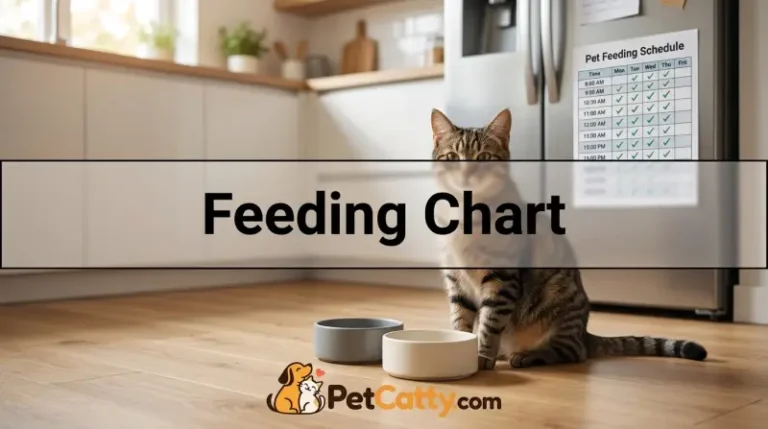
Divide the daily portion into equal servings. Feed at the same times each day. Don't leave food out all day.
Free-feeding leads to overeating and weight gain.
Measure the morning portion. Measure the evening portion. Stick to it.
Your cat will adjust to the schedule within a week.
Step 7: Adjust Based on Body Condition
This is the most important step. After two weeks on the calculated amount, check your cat's BCS again. If the ribs are still too prominent, increase the portion by 10%.
If the ribs are hard to feel, decrease the portion by 10%.
Repeat every two weeks until your cat maintains a BCS of 4 or 5. Once you find the right amount, it should stay stable for months. Recheck every four to six weeks to catch any changes early.
The process sounds like a lot of work. It takes less than five minutes a day. The payoff is a cat that stays at a healthy weight, has more energy, and lives longer.
That's worth the effort.
The Biggest Mistakes Cat Owners Make
Even with the best intentions, cat owners make predictable errors. Here are the most common ones and how to avoid them.
Free-Feeding Dry Food
Leaving a bowl of kibble out all day is the number one cause of feline obesity. Cats are grazers by nature. But when food is always available, they eat out of boredom, not hunger.
The result is a calorie surplus that adds up fast.
The fix is simple. Switch to scheduled meals. Measure the portion.
Put the bowl down for 20 to 30 minutes. Then pick it up. Your cat will learn to eat when food is available.
Trusting the "Average Cat" on the Bag
Feeding charts on food bags are designed for intact, moderately active adult cats. Most pet cats are spayed or neutered, indoor, and less active. That means the chart likely overestimates their needs by 20 to 30%.
Use the chart as a rough guide. But rely on the BCS and the calorie calculation for the real answer.
Ignoring Treats in the Daily Total
Treats are not free calories. A single treat can contain 5 to 20 calories. If you give your cat five treats a day, that's 25 to 100 extra calories.
That can push a cat from maintenance into weight gain territory.
The rule is simple. Treats should make up no more than 10% of your cat's daily calorie intake. If your cat needs 200 calories, treats should provide no more than 20 calories.
That's one or two small treats.
Measuring by Volume, Not Weight
A measuring cup is not accurate. The same cup can hold 10 to 20% more or less kibble depending on how you fill it. A kitchen scale is the only reliable way to measure.
Spend 15 dollars on a kitchen scale. It will pay for itself in reduced vet bills.
Overfeeding After Spay or Neuter
After surgery, a cat's calorie needs drop by 20 to 30%. But many owners keep feeding the same amount. The cat gains weight rapidly.
This is the most common trigger for feline obesity.
Reduce the portion immediately after surgery. Recalculate using the neutered indoor multiplier of 1.0 to 1.2. Check the BCS every two weeks and adjust.
Underfeeding a Picky Eater
Some cats are naturally picky. They eat less than the calculated amount. Owners panic and increase the portion.
But the cat still doesn't eat it. The food goes to waste.
The real problem is often the food itself. The cat may not like the texture, flavor, or brand. Try a different food.
Transition slowly. But don't force-feed. If the cat is maintaining a healthy BCS, they may simply need fewer calories.
Skipping the BCS Check
The scale can lie. A cat can lose muscle and gain fat while staying the same weight. The BCS catches that.
Skipping the BCS check means you're flying blind.
Make it a habit. Two minutes every two weeks. It's the best investment you can make in your cat's health.
Feeding Kittens vs. Seniors vs. Indoor Cats
Different life stages mean different needs. Here's how to adjust for each.
Kittens: High Energy, High Frequency
Kittens grow fast. They need two to three times the calories per pound as adults. A 2-pound kitten needs about 120 to 180 calories per day.
That's three to four small meals.
Feed a kitten-specific formula. It has more protein, fat, and calcium for growing bones. Free-feeding is acceptable for the first four to six months.
After that, switch to scheduled meals.
At six months, start transitioning to adult food. Reduce the portion gradually. By 12 months, most kittens can eat adult food at adult portions.
Seniors: Lower Metabolism, Different Risks
Senior cats need fewer calories than adults. Their metabolism slows down. They're less active.
But they also lose muscle mass. The goal is to maintain weight without gaining fat.
Feed a senior-specific formula. It has fewer calories but more protein to preserve muscle. Check the BCS every two weeks.
If the cat is losing weight, increase the portion. If the cat is gaining weight, decrease it.
Seniors also need more moisture. Kidney disease is common in older cats. Wet food provides hydration.
Dry food does not. If your senior cat eats dry food, make sure they drink plenty of water.
Indoor Cats: The Easy-Keeper Problem
Indoor cats are the most challenging to feed. They have low activity levels. They burn fewer calories.
They're prone to boredom eating.
Start with the lower end of the calorie range. Use the neutered indoor multiplier of 1.0. Check the BCS every two weeks.
If the cat is gaining weight, reduce the portion by 10%.
Enrichment matters. Provide toys, scratching posts, and climbing trees. A bored cat eats more.
A stimulated cat is happier and healthier.
Outdoor Cats: Higher Calorie Burn
Outdoor cats are more active. They patrol territory, hunt, and explore. They need more calories than indoor cats.
Use the outdoor multiplier of 1.2 to 1.4.
But outdoor cats also face risks. They may eat prey or get food from neighbors. That adds calories you can't control.
Check the BCS every two weeks. Adjust the portion down if the cat is gaining weight.
Special Considerations for Health Conditions
Health conditions change the calorie math. Here's what you need to know.
Diabetes: Consistency Is Key
Diabetic cats need consistent calorie intake. Meals should be at the same time every day. Use a high-protein, low-carbohydrate diet.
Wet food is better than dry food because it has fewer carbs.
Work with your veterinarian to set the calorie target. Adjust the insulin dose based on the food intake. Never change the food amount without consulting your vet.
Kidney Disease: Phosphorus Restriction
Cats with kidney disease need a diet low in phosphorus and protein. The calorie target is the same as a healthy cat. But the food is different.
Use a veterinary renal diet.
Hydration is critical. Wet food provides moisture. Dry food does not.
If your cat eats dry food, add water or broth to increase moisture.
Hyperthyroidism: High Calorie Needs
Hyperthyroid cats have a fast metabolism. They burn calories quickly. They may eat a lot but still lose weight.
They need more calories than a healthy cat.
Feed a high-calorie diet. Use the active multiplier of 1.2 to 1.4. Monitor the BCS every two weeks.
If the cat is still losing weight, increase the portion. Work with your vet to manage the condition.
Obesity: Weight Loss Under Supervision
Obese cats need a weight loss plan. But never start a weight loss diet without veterinary supervision. Rapid weight loss can cause hepatic lipidosis, a serious liver condition.
The target is 1 to 2% body weight loss per week. Use the weight loss multiplier of 0.8. Feed a high-protein, low-calorie diet.
Measure every portion. Check the BCS every two weeks.
The Hepatic Lipidosis Danger
Hepatic lipidosis is a life-threatening condition. It happens when a cat stops eating for more than 24 to 48 hours. The body releases fat into the liver.
The liver can't process it. The cat gets sick.
Never fast a cat for weight loss. Never force a cat to lose weight quickly. If your cat stops eating for more than 24 hours, call your vet immediately.
How to Transition Your Cat to a New Food Safely
Cats are creatures of habit. Sudden food changes cause digestive upset. Here's the safe way to switch.
The 7 to 10 Day Transition Schedule
| Day | Old Food | New Food |
|---|---|---|
| 1 to 2 | 75% | 25% |
| 3 to 4 | 50% | 50% |
| 5 to 6 | 25% | 75% |
| 7 to 10 | 0% | 100% |
Mix the two foods together. Offer the same total portion. If your cat refuses the mix, go slower.
Extend each phase by two days.
Why Sudden Changes Cause Problems
Cats have sensitive stomachs. A sudden change in food can cause vomiting, diarrhea, or gas. The digestive system needs time to adjust to the new ingredients.
The transition schedule gives the gut time to adapt. It also gives your cat time to accept the new taste and texture.
What to Do If Your Cat Refuses the New Food
Some cats are stubborn. They refuse to eat the new food even when mixed. Here's what to do.
First, check the temperature. Warm food is more aromatic. Heat the wet food for 10 seconds in the microwave.
Mix it well to avoid hot spots.
Second, try a different texture. Some cats prefer pate. Others prefer shreds or chunks.
Experiment to find what your cat likes.
Third, add a topper. A small amount of freeze-dried chicken or fish can make the food more appealing. Keep the topper under 10% of the daily calories.
If your cat still refuses, consult your vet. There may be a medical reason for the refusal.
Wet Food vs. Dry Food vs. Raw: What's Best for Portion Control
The type of food affects how easy it is to control portions. Here's a breakdown.
| Factor | Wet Food | Dry Food | Raw |
|---|---|---|---|
| Calorie density | Low (70-110 kcal per 3oz can) | High (300-450 kcal per cup) | Moderate (depends on recipe) |
| Moisture content | 75 to 85% | 6 to 10% | 70 to 75% |
| Portion control | Easy (single-serve cans) | Difficult (cups are inaccurate) | Moderate (requires weighing) |
| Cost per calorie | Higher | Lower | Highest |
| Dental health | No benefit | Some benefit (myth, mostly) | Minimal |
| Convenience | High | Very high | Low |
Wet Food: Best for Portion Control
Wet food is the easiest to portion accurately. Cans are single-serve. You know exactly how many calories are in each can.
Wet food also provides hydration, which is important for urinary health.
The downside is cost. Wet food is more expensive per calorie than dry food. It also spoils quickly.
Uneaten food should be refrigerated and used within 24 hours.
Dry Food: Convenient but Risky
Dry food is convenient. It's cheap. It doesn't spoil.
But it's calorie-dense and easy to overfeed. A single cup can contain 300 to 450 calories. That's a whole day's allowance for a small cat.
Dry food also has low moisture content. Cats who eat only dry food are at higher risk for urinary tract issues. If you feed dry food, make sure your cat drinks plenty of water.
Raw: Requires Careful Balancing
Raw diets are popular but controversial. They require careful balancing of nutrients. They also carry a risk of bacterial contamination.
If you feed raw, use a commercial raw diet that is AAFCO-approved. Homemade raw diets should be formulated by a veterinary nutritionist.
Portion control with raw is moderate. You need to weigh the food. Calorie density varies by recipe.
Follow the manufacturer's guidelines.
Mixed Feeding: Best of Both Worlds
Many owners feed a mix of wet and dry food. This gives the benefits of both. The wet food provides moisture and portion control.
The dry food provides convenience and cost savings.
Calculate the total calories from both sources. Divide the portion accordingly. For example, if your cat needs 200 calories, feed one 3-ounce can of wet food (80 calories) and 1/4 cup of dry food (100 calories).
That's 180 calories total. Adjust as needed.
When to Call the Vet
Some situations require professional help. Here's when to call your vet.
Signs Your Cat Is Underweight Despite Eating
If your cat is eating the calculated amount but still losing weight, something is wrong. Possible causes include hyperthyroidism, diabetes, or intestinal parasites. Your vet can run tests to find the cause.
Signs Your Cat Is Overweight and Not Losing
If your cat is eating the reduced portion but not losing weight, the portion may still be too high. Or there may be a medical issue. Hypothyroidism is rare in cats but possible.
Your vet can help.
Sudden Changes in Appetite
A sudden increase or decrease in appetite is a red flag. It could signal diabetes, kidney disease, or dental pain. If your cat stops eating for more than 24 hours, call your vet immediately.
Hepatic lipidosis can develop quickly.
Before Starting Any Weight Loss Plan
Never start a weight loss diet without veterinary supervision. Your vet can set a safe target rate of 1 to 2% body weight loss per week. They can also rule out medical causes of obesity.
For Kittens, Seniors, and Cats with Health Conditions
Kittens need more frequent monitoring. Seniors need regular checkups. Cats with health conditions need a tailored diet.
Your vet is your best resource for these cases.
The Bottom Line: A Simple Feeding Plan You Can Stick With
Here's the short version. Calculate your cat's RER. Apply the right modifier.
Read the food label. Measure with a kitchen scale. Split into two meals.
Check the BCS every two weeks. Adjust the portion by 10% as needed.
That's it. The process takes five minutes a day. The payoff is a cat that stays at a healthy weight, has more energy, and lives longer.
Trust your vet. Trust your eyes. Trust the scale.
And remember that the feeding chart on the bag is a starting point, not the final answer.
Frequently Asked Questions
How much should a 10-pound cat eat per day?
A 10-pound neutered indoor cat needs about 200 to 250 calories per day. That's roughly one cup of dry food or two to three 3-ounce cans of wet food. Check the body condition score every two weeks and adjust the portion by 10% as needed.
Can I leave dry food out all day for my cat?
Free-feeding dry food is the leading cause of feline obesity. It's better to switch to scheduled meals. Measure the portion, put the bowl down for 20 to 30 minutes, and then pick it up.
Your cat will learn to eat when food is available.
How many times a day should I feed my cat?
Two meals per day is standard for adult cats. Three meals is fine for kittens or cats with medical needs. Divide the daily portion into equal servings.
Feed at the same times each day for consistency.
How do I know if my cat is overweight?
Check the body condition score. You should feel the ribs with a light touch. There should be a visible waist behind the ribs.
There should be a slight belly tuck from the side. If the ribs are hard to feel or the belly hangs down, your cat is likely overweight.
What if my cat is a picky eater?
Try a different food texture or flavor. Warm the food to increase aroma. Add a small amount of freeze-dried chicken or fish as a topper.
If your cat still refuses to eat for more than 24 hours, call your vet.
Can I feed my cat homemade food?
Homemade diets require careful balancing of nutrients. If you feed homemade, consult a veterinary nutritionist. Commercial raw diets that are AAFCO-approved are a safer option.
Never feed homemade diets without professional guidance.
How do I transition my cat to a new food?
Use the 7 to 10 day transition schedule. Start with 75% old food and 25% new food. Gradually increase the new food over 10 days.
If your cat refuses the mix, go slower. Extend each phase by two days.
How many treats can I give my cat per day?
Treats should make up no more than 10% of your cat's daily calorie intake. If your cat needs 200 calories, treats should provide no more than 20 calories. That's one or two small treats.
Adjust the food portion to account for treat calories.